Cathi Sell has been chosen as one of the elite squad for the Youth Circus for Glasgow's Commonwealth Games......
See Scotsman preview link:
http://www.scotsman.com/lifestyle/meeting-the-commonwealth-youth-circus-performers-1-3216840

Tuesday, December 3, 2013

Sunday, December 1, 2013
Friday, August 9, 2013
Edinburgh Reviews - TOTAL THEATRE MAGAZINE - Dorothy Max Prior
Apocalypso! Our culture is awash with images of violence, destruction, despair and degradation. 24-hour news coverage beamed from war-torn countries, TV documentaries exposing the use of torture, gory and sadistic films, shoot-em-up video games. Almost daily we encounter yet another dystopia, another vision of apocalypse – the end is nigh, it seems. The end is never-ending.
How do we process these images? How do we assimilate and evaluate them? Dudendance’s This Side of Paradise grasps the conundrum by the short and curlies and beats out an answer with a cleverly manipulated use of site, intriguing imagery, and engaging physical performance.
We are first invited into a chamber of horrors that is all the more desolate for the fact that it is daylight lit – the Autopsy Room, a high-ceilinged space with a dust-smeared glass roof, cracked tiles, deep sinks, a cupboard full of ominous looking tools and medicinal bottles, and a big pulley hanging above. (‘Maximum load one tonne.’) As is often the way with truly site-specific theatre, it is hard to tell what is found object and what has been placed as ‘set’ or ‘prop’. There’s a pile of mattress stuffing and rags on the floor that seems to be moving, a hospital gurney that has what might be a human figure on it, and an ape-like man with clenched knuckles chained to the wall, dragging himself to and fro. He wears ripped and torn joggers, patched together with gaffer tape, and a skewed balaclava that reveals just one eye.
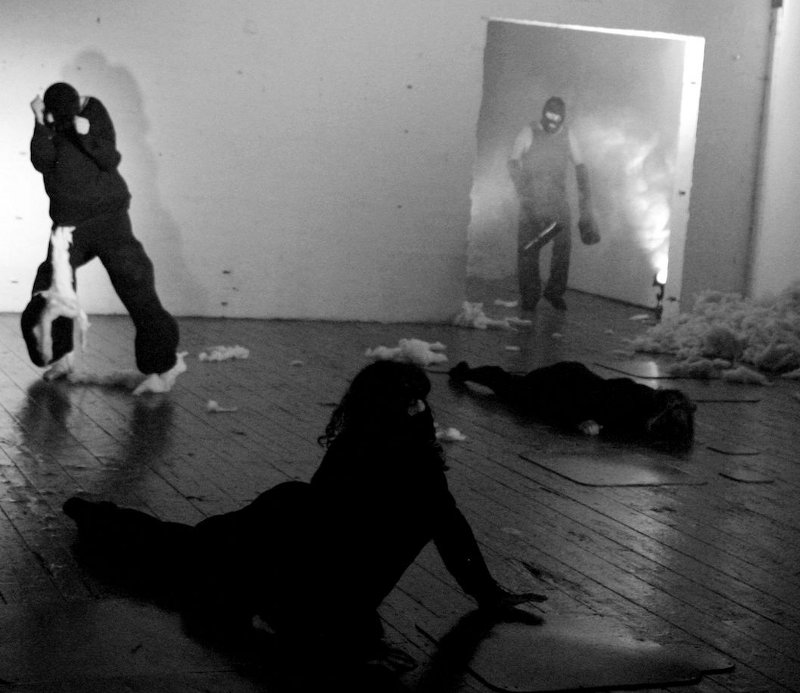
A melancholy usher, also wearing a balaclava, escorts us into the neighbouring Demonstration Room, which by contrast is in almost- darkness. This room is occupied by a number of writhing figures, stuffed in strange ways so that they seem more puppet than human figure – horrible deformations of the human form that are headless or spineless or abnormally long-bodied. Mutants! The ape-man and another one-eyed figure seem to be the ‘guards’, manipulating and tormenting the other figures. Just when it reaches a point in the show where the point seems to have been made, enough already, a shift occurs. With the introduction of kitsch lounge music and vocalised ‘pows’ and ‘kerrangs’, the world witnessed slips into cartoon violence, humour releasing the tension that has been held taut. Ape-man morphs into a ludicrous club-armed creature rampaging round the space, others wield tacky cardboard weapons and toy guns. We’ve moved from nightmare terror to Hallowe’en party horror.
This Side of Paradise uses its chosen site very carefully and beautifully (if I can use that word of something exploring the opposite of beauty). The opening and shutting of doors that allow in a limited ration of light in the main (second) space; the movement of the performers through the spaces; the careful integration of the found objects/physical aspects of the site into the dramaturgy of the piece. The choreography is fluid, precise, meaningful – I particularly like the puppeteer-puppet dynamic explored between the various pairings of performers.
It’s a dark subject, but there is humour for those happy to find the dark side of life amusing – and those who are this way inclined might spot some of the many passing references to video gaming, comic book and film characters – from the shadowy Nosferatu to the lurching zombies of Resident Evil, via Batman and The Hulk.
Made by Scottish company Dudendance (Paul Rous and Clea Wallis), in collaboration with artists from Campinas, Brazil and a group of young Scottish performers were trained in residence in Brazil and with Dudendance in Scotland. Paul Rous (the ape-man cum club-armed monster) is, as always, a mighty physical presence on stage. The rest of the team work well together, and it is all very ably directed by Clea Wallis. There is nothing so entertaining as other people’s misery.
Go to Summerhall Link
http://festival.summerhall.co.uk/event/this-side-of-paradise/
Broadway Baby ****
Go to Summerhall Link
http://festival.summerhall.co.uk/event/this-side-of-paradise/
Broadway Baby ****
| BROADWAY BABY REVIEW | |||
Paradise Found |
| ||

The performance began in a small room to the side of the theatre space. This room is a former abattoir and meat hooks, veterinary equipment, a dissection table and intriguing cabinets have been left in the former Edinburgh University Veterinary School building that is now the Summerhall venue. To add to the unnerving strangeness the audience was beckoned into the room by a faceless man, clad in black and wearing a concealing balaclava. On the floor was a heap of white foam with what appeared to be a human in a white body sock lying underneath. This convulsing and pulsating white body could represent purity and goodness, but it definitely conveyed mystery and tension.As the audience absorbed this peculiar scene, we were beckoned into the theatre space to take our seats, relieving some of the tension and allowing us to draw breath and consider what would happen next. The theatre was dark and a muffled motor sound pulsed around the room. This eerie soundtrack heightened the intensity and added to the bizarreness that ensued. On the floor of the stage further black clad bodies were present, awkwardly moving and curiously interacting with one another as if they were coming to terms with their environment and their bodies.
At around fifteen minutes into 'This Side Of Paradise' we see our first human face as one of the performers removes his black balaclava. Unfortunately this shatters some of the mystery. The bodies were augmented with body suits that distorted their anatomy and the performers movement had had more in common with deranged robotics, but now we have our first glimpse of reality. During this moment the soundtrack also stopped and the pace of the performance changes. 1970's funk and soul music bursts from the speakers, further breaking the illusion that we were in a dark fantasy and giving the performance a grounding in place and time that initially went against the grain of the unsettling piece. However, as the funk blared out and the performers made use of props to develop their characters, the juxtaposition of music and physicality blended together to create an enjoyable and finely crafted example of physical theatre that his hard to peg down. The performance ends in the side room, where we see the white convulsing body on the dissection table. This time the body is motionless, that is until the face is revealed. We see a woman who has searching eyes that scream for help. One of the black clad men held medical instruments and began to conduct his own experiments on the woman's face. The stage doors are then opened and the audience is beckoned to leave. An ambiguous ending to an ambiguous performance. |  
Reviewer:
Steven Fraser
Steven Fraser has written 30 reviews for Broadway Baby since joining the team in 2013.
|
Monday, June 24, 2013
Monday, November 12, 2012
Huntly Halloween 2012- images by Jan Holm
.jpg) |
| Gordon Black in the shop window. |
.jpg) |
| Deborah May dancing in shop window. |
.jpg) |
| Cathi and Gordon fight scene. |
.jpg) |
| Paul enters the crowd with giant robot arms. |
Monday, October 22, 2012
Glue Factory pictures by Lisa Craig
Video games were invented using military technology to simulate battle situations - we wanted to explore how torture and violence are used in entertainment, film, video and gaming. Where do we draw the line between reality and fantasy ?
In October 2012 This Side of Paradise was located at the Glue Factory in Glasgow. Dudendance rehearsed the piece within the site and created a walk-though environment peopled by mutant creatures who created and destroyed themselves with wads of stuffing. The piece was set into adjoining spaces allowing the audience to see several spaces at once.
The morphing action builds into a slow motion full- scale fight choreography - the creatures eventually smashed by Paul Rous's giant robot arms. The piece ends with the creatures re-forming into mutant robot type figures continuing their never ending cycle of violence.
 |
| Deborah May stuffs herself into hideous mis-shapes. |

 |
| Cathi Sell moves through the floor unable to stand up. |
 |
| Dora de Andrade manipulates and smashes a dummy before turning on the others. |
 |
| Slow motion fight.... |


 |
| Paul destroyer arms. |
Mary Brennan Review for Glue Factory performance 15th Oct.
This Side of Paradise, Arches@TheGlue Factory, Glasgow
Dance critic
Last October, this was a work-in-progress at the Arches. ****
A year on, Dudendance returned with a new version of the work, tailoring it to suit the dank chill of the Glue Factory. The film noir sub-stories were stripped out, leaving the nameless, faceless threat of black-clad mutants – lumpen, mis-shapen forms with robotic gait – to invade the dim-lit rooms, like vengeful escapees from some war-based video game.
Their blindly relentless aggression wasn't aimed at us. But the uncertainty hovered: what if technology went rogue? Our gizmos turned against us? An evil genius manipulated machines that wouldn't die, but reactivated to keep on killing? The stuff of such sci-fi nightmares astutely taps into the primal fears we harbour still. And even when the soundscore edged into cha-cha-cha cheesiness, or Paul Rous (co-director of Dudendance, with Clea Wallis) lumbered on like a manga slayer, one arm a huge hammer the other a club, the black humour was countered by four battered creatures reviving in order to start another cycle of destruction between us and the exit.
Monday, October 1, 2012
Glasgow Dates
A group of mutant characters assemble themselves using wads of stuffing and removable limbs. Stiff with the technical language of war, an isolated voice offers help, providing them with instruction on how the body fits together and operates. Each action brings them closer to violence.
Cartoon grotesquery and dark humour collide in this site-specific performance installation from experimental dance-theatre company Dudendance, first shown as a work-in-progress at the Arches last October.
Performances from t
he 11th-14th October. 7.30 pm
The Glue Factory is a ten-minute walk from Cowcaddens subway (follow Garscube road) or from St. George's Cross subway along St. George road.
Tickets available from the Arches website, or to reserve from the Arches box office.
http://www.thearches.co.uk/events/ arts/ this-side-of-paradise-2

Posts
Wednesday, September 5, 2012

Sunday, August 26, 2012
New production from Dudendance

Rehearsals are going well! Our work over the summer on 'This Side of Paradise' is to be put into the space in Glasgow in a weeks time, bringing the piece from our rehearsal base in Aberdeenshire to the Glue Factory in Glasgow where we will perform later in the year for four days, from the 11th of October! Put it in your diaries! Its going to be a good one!
Photo by Jan Holm
Wednesday, June 27, 2012
Dudendance at The Living Museum Alford Old Mart and Heritage Centre July 2012 - work-in-progress

Performance Installation
Alford Heritage Centre
Mart Road
Alford
Sunday 22nd of July
12:30pm, 2:00pm, 3:00pm
Wednesday, May 16, 2012
Casa das Artes Embu

We arrived at the Casa das Artes in Embu after an intensive week at LUME theatre and a weekend spent in Sao Carlos.
In Sao Carlos we stayed with producer Patricia Souza Ceschi from Ayembere Productions who took us to an organic Fazenda (farm) where they are creating an ambitious project working with the children of the farmers with performance, art and circus. The local young people have access to a beautiful purpose built space including an outdoor theatre, a huge play area, a kitchen with clay ovens for cooking and an indoor performance space. We were impressed by the ambition of the project and exchanged our experiences of teaching young people in the rural environment of Huntly. We also looked at potential spaces in Sao Carlos and planned how we could combine a workshop at the Fazenda with performances of This Side of Paradise in 2013.
 The Casa das Artes residency centre is owned and built by film-maker and former Cirque du Soleil artist Kris Niklison. The impressive living/working space is combined in an open plan structure with high walls to accommodate trapeze and enormous wooden doors with panoramic views into the Atlantic rain forest. In rehearsals we were frequently joined by snakes, frogs, chicadas and stray dogs hiding from strong electric storms that threatened to hit the house. Sharing the residency with us were two clowns Daniel from Circus Zani and Danilo from Juego do Quintal.
Dora de Andrade exchanged her experience of working with her group in the favela of Ilha de Conceptcio in Rio. Dora has been working with teenage boys crossing a “gorilla“ group of traditional carnival characters with hip hop and site- specific performance. She has developed ideas with Dudendance through a long distance project and as part of her PHD thesis on collaborative process.
Cathi, Gordon and Deborah arrived from Huntly in the second week and spent a few days adjusting to the climate. The colonial town of Embu, a 30 min walk away, famous for it’s arts and crafts market, provided us with a typical slice of Brasil. Only 40 mins from the mega city of Sao Paulo, Embu feels like a world away and is a popular day trip for tourists who visit the workshops of craftsmen and artists based there.

 Our days were divided between training sessions in yoga, dance and voice, improvisation and devising. During the three week process we carried through the idea of the characters manipulating each other and transforming from human into hideous machines. We wanted to push the noir clichés into an exaggerated cartoon-like world and at the same time search for a truth behind the Americana façade. With so much nature and wild sounds surrounding the house we worked with being part animal and creating imaginary habitats. Cathi, Gordon, Paul, and Deborah wrote noir inspired text’s as voice-overs for their characters- each lone figure narrating their own imaginary movie. Fabiana Galante, composer and musician from Argentina joined us in the last few days to record the sounds surrounding the house and texts to be incorporated into a sound-scape.
  During our time in Embu we learnt a lot through interchange with our Brasilian peers. There was a refreshing interest in our work process which we shared through workshops and open rehearsals in LUME and Embu. The young performers from Scotland also had the opportunity to see first class Brasilian shows in Sao Paulo with it’s vibrant dance, physical theatre and circus scene.
 On the whole the process in Brasil was an amazing opportunity to exchange and be inspired by a different culture and gave the group a re-newed excitement and inspiration to create work. It was fantastic to be exposed to such an open, dynamic and warm-hearted arts community with physical performance at it’s heart. A famous saying is that Brasil is the land of improvisation. The experience in Brasil taught us to be adaptable to different audiences and be ready to perform a variation of work in a variety of spaces. We really look forward to strengthening our ties and bring the finished piece back in 2013.
 We also created links for Brasilian companies to come to Scotland. To date we have connected LUME Teatro to Glasgow based Conflux for their 2012-2016 interchange and music group Sambasupercollider from Rio with Deveron Arts in Huntly. Dancer Flavia Fernandes who took part in our workshop will join us in the summer for a cultural exchange and film-maker Felipe Barros is planning a film with Dudendance in the arid desert of north east Brasil in 2013.
  www.ayembere.com.br
 www.jogandonoquintal.com.br
Friday, April 6, 2012
Why Brasil?

The connection to Brasil started in 1992 when Dudendance were invited for a residency at the Imperial Palace in Rio. This led onto an invite from the International Festival of Theatre in Campinas to ran a large scale workshop at the university where Lume are based for the performance faculty of UNICAMP. Out of the workshop the company created a site-specific piece “Sphinx Hinter Gittern” which subsequently toured to festivals and was supported by the PT (workers party) to bring culture into shanty towns. The extended tour, which ran for two years, included a cast of four members of Dudendance and eighteen university students.
The experience in Brasil was life-changing and has had a strong influence on the way Dudendance have worked in the rural town of Huntly over the past ten years. Subsequent visits to Brasil have included the production of two short dance films and workshops and residencies at the Centro Coreografico in Rio. Dudendance have established a network of dancers and performers with whom they collaborate on a regular basis.
Thursday, April 5, 2012
LUME: Dance Theatre Workshop

 The context of the workshop was to share the starting point for This Side of Paradise by exploring the theme of physical manipulation. Dudendance have created a movement technique where the body is "moved" and manipulated like a life size puppet. Inspired by the silent movies of Buster Keaton, who is moved by elements outside of himself (the wind, rocks, water, machine) what develops is a physical struggle - a movement created by invisible forces. The group for This Side of Paradise used this in developing their noir influenced characters that are metaphorically locked in a struggle with their own fate. During the workshop ties are attached to the body allowing the person to be moulded into “simple” tasks such as sitting, standing, walking, getting dressed etc. This passive state is slowly replaced by an increased motivation to break away resulting in a playful fight between the performer and the manipulators. Once the ties are removed the performers repeat the whole process alone, recalling the “sense memory” of the task.
Wednesday, April 4, 2012
The Arches

'Every so often the Dudendance folk - Clea Wallis and Paul Rous - turn up at The Arches to give their followers a taste of what they get up to in their own base of Huntly.
This showing, not so much a work-in-progress as a selection of ideas that are bubbling under their work, picked up on themes that emerged during a recent summer project with local young people. Three of those Young Dudes – Deborah May, Cathi Sell and Gordon Black – are now immersed in a melting pot of text, movement and film sequences which play around with aspects of characterisation and behaviour.

 The mood is film noir, but given the Dudendance penchant for skewing familiar icons and introducing some shape-shifting and an element of animalistic behaviour, the cinematic genre gets an intriguing upheaval. There’s a degree of physical distortion: torsos are grotesquely puffed up with cotton wadding that cuts across any glimmers of glamour in gun-toting gangster, moll or law-man. Movement, too, alters the imagery. Black and Sell, lip-synching as no-goodniks on the run (Bonnie and Clyde, perhaps) wriggle and squirm like snakes, albeit through clumps of white wadding. Rous, padded and hatted, like a Desperate Dan look-alike, is the tippy-toed predator-gumshoe who subsequently interrogates the wonderfully fragile, butterfly flittery creature (Gloria Swanson in Sunset Boulevard?) portrayed by Deborah May.
As a starting point, it could go anywhere. What shows already, however, is the value of what Dudendance achieves in Huntly through a bold and ambitious programme of workshops and site-specific community pieces.' Mary Brennan, The Glasgow Herald, 21st of October.
This Side of Paradise The Arches, Glasgow
Monday, April 2, 2012


Into the Wild

Into the Wild was a public art project initiated by Dudendance in 2010, looking at what the woods means to local people, the place of 'wilderness' in the collective imagination and the importance of having 'unmanaged spaces'.
For Gordon Black and Cathi Sells, this was their first taster of working with Dudendance.
Sunday, April 1, 2012
This Side of Paradise's work process
 For the devising process we are using film-noir themes in a broad sense. The desperate and animalistic quality of the characters, their survival instinct and deluded nature, draws us into their underworld. By watching classic noir films such as Sunset Blvd. - including spin-offs by directors such as Scorsese and Cassavettes, we have acquired a feeling for the emotional journey encountered by a ‘typical’ noir character.
In improvisation each performer creates their own series of scenarios linked to emotions, objects and situations that form a stream; a non-linear narrative. The emotions, based on the ‘noir motives’ of greed, paranoia, seduction, fear, doubt and revenge are played out using guns, cigarettes, money, telephones and drink. Padded cushions are beaten up and the contents used for stuffing, bloating the characters into hideous, cartoon-like versions of themselves.
We find ourselves repeatedly questioning ‘why noir?’, ‘why use these clichés?’
The clichés of noir surface time-after-time in different guises because they have a ring of truth. In our celebrity-obsessed world we are fascinated by fallen icons – lost souls with big dreams, whose fate ends in the gutter. The naïve aspirations of the American dream no longer seem relevant, and the anti-dream/ anti-hero still holds strong because most of us don’t make it onto X factor.
Subscribe to:
Posts (Atom)